
Q&A with Dr Valeria Bodishtianu: What Every Student Should Know Before Starting University
Moving away from home, starting university and settling into a new community can feel exciting, daunting and, at times, overwhelming.
We spoke with Dr Valeria Bodishtianu, Resident Fellow at St Catherine's College and Lecturer in Economics at The University of Western Australia Business School about building friendships, succeeding academically and why living in a residential college can make the transition to university easier.
Originally from Russia, Dr Bodishtianu completed her PhD in Economics at Cornell University before joining UWA in 2025. Her research explores how people form beliefs, make decisions and interact with information in an increasingly digital world.

Dr Valeria Bodishtianu, Resident Fellow at St Catherine's College and Lecturer in Economics at The University of Western Australia.
You’ve studied and worked in Russia, the United States and Australia. What have those experiences taught you about adapting to new environments and finding a sense of belonging?
I think moving countries teaches you that, before you can get to the grand questions of identity and belonging, you first have to solve a ridiculous number of small practical problems that you somehow never anticipated.
When I arrived in the United States for my PhD, I had remembered that I would need bed sheets, but for some reason it had not occurred to me that I would also need a towel. Buying a towel on your first day is surprisingly complicated when you do not yet know where the shops are, whether the bank card from your home country will decide to work or whether the shops even accept cash.
“Adapting is much easier when there is even one person on the inside, or at least one person standing next to you being equally confused.”
Some of the bigger practical problems had started even before I arrived. Housing, banking, money transfers and taxes suddenly become very important when you are the person who has to make them work on your own. What really helped me was another student from my cohort who reached out before the program started. We ended up renting the same house, helping each other figure things out, and she was also the person who bought me that towel on my first day. I still have it and am probably more emotionally attached to it than most people would be.
That experience taught me that adapting is much easier when there is even one person on the inside, or at least one person standing next to you being equally confused. The structure of a university program, and especially a residential college, helps with that because everyone is navigating the same unfamiliar experience together. Students often assume everyone else already knows how university works, when in reality most first-year students are figuring it out together.
For me, belonging came through repeated contact rather than one brave social decision. I kept seeing the same people and, over time, they became part of my life. I still remember being invited to my first Halloween party and later my first Diwali celebration. Those invitations felt like signs that I was becoming part of other people's routines and traditions.
I don't remember one moment when university suddenly felt like home, but I do remember returning from Russia one year and realising that, although I was sad to leave my family, I was also excited to go back because my friends, my apartment and my work were waiting for me. That was when I realised adapting doesn't require replacing one home with another. Eventually, you can become attached to both.
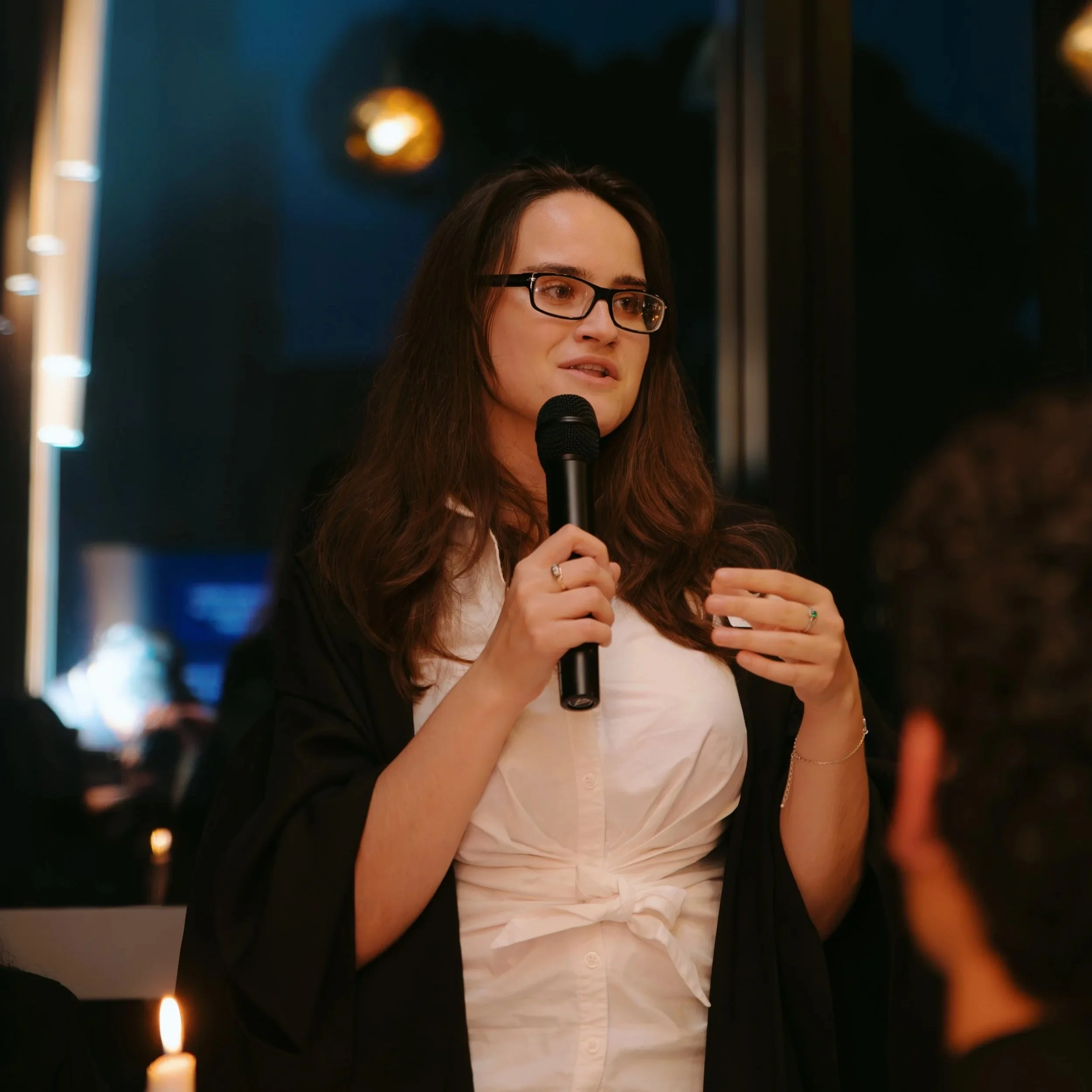
Dr Valeria Bodishtianu speaking at the St Catherine's College Faculty & Industry Dinner, The Attention Economy.
What advice would you give a student who is nervous about moving away from home and starting university?
I think the first thing to say is that being nervous is a very normal reaction, especially if this is the first time you've lived away from home. There is the emotional side of missing home and facing uncertainty, but there is also the very practical feeling of wondering, "What do I do now?" Things will absolutely get better, but that's not especially helpful when you're sitting alone in a new room.
So my advice is very practical: go to the things that are already being organised around you. Go to dinner, orientation events, College activities and all the random festivals and occasions happening on campus, even when you don't know anybody and aren't entirely convinced you want to go.
You do not need to become an extremely extroverted person overnight. You simply need to leave your room often enough for other people to become familiar.
This is one of the major advantages of living at St Catherine's. Students do not have to invent a social structure or manufacture a reason to approach strangers. The activities already exist, people are expected to attend them, and repeated contact happens naturally. Even if the first few conversations are simply small talk, they make the place feel less unfamiliar, and friendships usually grow from those ordinary interactions.
I would also encourage students to ask for help when they need it, particularly from the people whose job it is to provide it. It can feel awkward to admit confusion to your peers when you've only just met them, but lecturers, tutors, Resident Fellows and College staff are not waiting to judge whether your question is impressive—we're here to answer it. There is no prize for making university unnecessarily difficult by refusing to use the available support.
Finally, I'd recommend finding people to study with early, rather than waiting until you're completely stuck and trying to build an academic support network overnight. Even if you're capable of doing most of the work alone, everyone eventually encounters something they need help with. It's much easier if you already have that network in place.
From your perspective as both a lecturer and Resident Fellow, what role do community and wellbeing play in student success?
Community matters because university is usually easier to manage with other people around you, both academically and personally. A student's academic experience is shaped by whether they have people to study with, people who make it easier to show up and people who make the whole experience feel less lonely.
From an academic perspective, studying with other people helps directly. It creates accountability, which is useful because procrastination is hardly an unusual student problem, but it also makes the work easier. Different people get stuck on different parts of the same task, and a problem that has eluded you for three hours may be solved by somebody else looking at it for thirty seconds. Mildly annoying at times, perhaps, but still preferable to remaining stuck.
“I hope students leave with close friendships, a strong network and, perhaps most importantly, the confidence to face problems they haven’t encountered before.”
During my undergraduate degree and PhD, I also found that friends from other disciplines were some of the most valuable people to talk to. Even if they didn't understand all the technical details of my work, explaining an idea to someone outside the field forced me to decide what the actual idea was. If it couldn't survive without ten minutes of specialist background, that was usually a sign the explanation still needed work.
Wellbeing matters because students need enough stability to make the most of their abilities. University is, and should be, challenging, but students should never feel they have to face those challenges alone.
That's where community and wellbeing come together. A good community gives students people to learn with, to complain with, to get through busy assessment periods with and, eventually, people who remind them that regardless of the deadlines, the body still needs occasional rest.
Your research explores how people form beliefs, make decisions and interact with information. What lessons from your research do you think are particularly valuable for university students today?
The problem today is not a lack of information so much as an excess of it. We encounter more claims than we could possibly investigate, often while scrolling quickly through social media, and repetition alone can make an idea feel familiar and therefore more plausible.
It's important to remember that intelligent people can, and quite often do, believe misinformation. It can be comforting to assume that we believe the truth because we are rational while other people believe falsehoods because something is wrong with them. In reality, all of us are affected by confirmation bias, motivated reasoning and the limits of our own attention.
Another lesson from game theory and decision-making is that good decisions often depend on understanding the structure around the decision, not just the intention of the person making it. Sometimes the strategy that feels psychologically easier in the moment is not the one that gives you the best outcome.
A lot of poor outcomes don't happen because people are irrational or malicious. They happen because each individual decision makes sense in isolation, while the overall pattern gradually becomes problematic. Learning to step back and look at the bigger picture is a valuable skill, both at university and beyond.
What makes living at St Catherine's College different from other student accommodation options, particularly for regional and international students?
Many accommodation options can give a student a room, but they do not necessarily give them a life around that room. For me, the main difference at St Catherine’s is the combination of a residential community and a structure that makes regular interaction almost unavoidable – in a good way!
Students see the same people at meals and activities, which allows friendships to develop without every interaction having to be deliberately arranged. The College calendar is almost always full, which is incredibly valuable because students do not have to invent reasons to meet one another or wonder whether they are intruding by attending; they are already invited and, in most cases, eagerly expected.
“Students do not have to invent a social structure or manufacture a reason to approach strangers.”
For regional and international students, the practical difference begins before they even arrive. Finding housing from another city or country can be extremely stressful, particularly when the rental market is difficult and you are trying to make financial arrangements in an unfamiliar system. I remember how hard that was when I moved to the United States; and although I was a much more experienced traveler by the time I moved to Perth – and, obviously, a more adult person in general – Perth still managed to unpleasantly surprise me by being one of the hardest cities I have had to navigate from a housing perspective.
At St Catherine’s, students know that a room is waiting for them and that they are arriving somewhere designed for people who may be living away from home for the first time. There are staff and RAs and Resident Fellows they can approach about the things that are obvious to locals but not at all obvious to somebody who has just arrived, and there are other students going through the same transition. For an international student in particular, having that person on the inside can make a huge difference. They may need help understanding banking, transport or university systems, but they also need people to talk to and ordinary opportunities to become part of the place.
What do you hope students gain from their time at St Cat’s beyond their degree?
I hope they leave with close friendships, a strong network (goes hand in hand) and, maybe most importantly, practical confidence to face a problem they have not seen before. A university or a college can give you many useful things, including, unsurprisingly, actual knowledge in your degree; but the number one thing it will give you is grueling and repeated practice in being faced with new unfamiliar problems, having no idea in how to approach them, and having to work your way through the whole situation anyways.
A lot of adult life is just a sequence of problems that arrive with no solution attached; at St Cat’s, at least, you are not supposed to face them alone. You have staff, and tutors, and friends around you; there are people who can help even when the problem feels impossible because you have never had to deal with it before. It is a little like training wheels: the problems are real, but the consequences are usually lower and there is still somebody nearby to stop the entire bicycle from going into a ditch.
“University is, and should be, challenging, but students should never feel they have to face those challenges alone.”
Living around other students also matters because everyone is figuring things out at the same time. You gradually learn that confusion is not a personal failure and that asking somebody else is often the most efficient way forward. You also learn by watching how other people deal with ordinary situations. Spending time around other people slowly expands your sense of what can be done, because you keep seeing approaches that would never have occurred to you on your own.
So beyond the degree, I hope students leave St Cat’s with people they trust, but also with the confidence to be less fazed by uncertainty. They will not always know the answer, which is normal and will continue to be normal long after university, but ideally they will know where to start and will no longer assume they have to do all of it alone.
About Dr Valeria Bodishtianu
Dr Valeria Bodishtianu is a Resident Fellow at St Catherine's College and Lecturer in Economics at The University of Western Australia Business School. Originally from Russia, she completed her PhD in Economics at Cornell University before joining UWA in 2025. Her research explores information economics, political economy, networks and artificial intelligence, examining how people form beliefs, make decisions and interact in digital environments.
Learn more about living at St Catherine's College or book a tour.