
Resident Spotlight: Connor Maloney, Global Voices Fellow
Connor Maloney is a Curtin University student and recipient of the prestigious Global Voices Fellowship. Originally from Esperance, Connor is studying international relations and security while pursuing opportunities in leadership, research and public policy. We spoke with Connor about his journey from regional WA to Curtin, student leadership and global policy discussions.
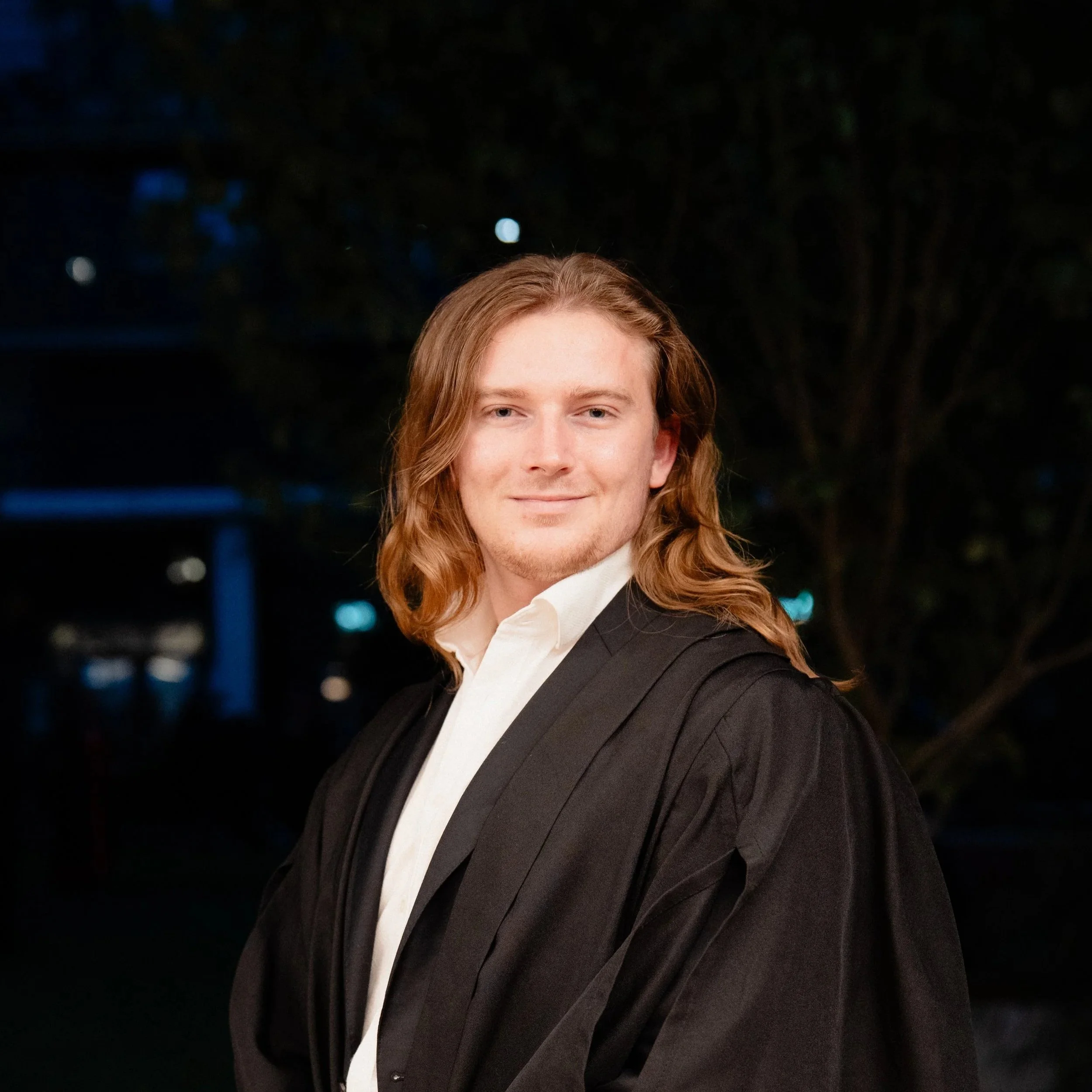
Connor at the Christmas in Narnia themed Valedictory Dinner at St Catherine’s College, Curtin
Q&A with Connor
How has growing up in Esperance shaped your perspective and ambitions?
Growing up in Esperance, I like to think, has kept me grounded. Living in a regional town gives you a strong sense of community early on; you notice how much people rely on one another and how quickly the effects of political and economic decisions are felt locally. At the same time, it gives you a genuine appreciation for distance, not just geographic distance, but the gap between where decisions are made and where their consequences are felt. The decisions made in Perth or Canberra have far-reaching impacts on regional communities whose voices aren't always in the room.
I think leaving Esperance for university also made me realise how much that background shaped me. You become aware that regional students often approach opportunities differently because you've grown up understanding that access isn't always guaranteed.
That reality never left me. If anything, it's been one of the reasons behind my ambitions, that drive to earn a seat at the table, to have influence, to matter. It sounds simple, but for a lot of regional students, it's the most honest version of why we push as hard as we do.
What first sparked your interest in international relations, security and global policy?
There was never a single defining moment. History was always the subject I was most drawn to at school. I was fascinated by the way ideas, technologies and power shape one another, and by how decisions made by individuals or governments can alter the course of entire societies.
I think part of that curiosity also came from growing up somewhere geographically isolated. Living in a regional community makes you conscious that events happening far away, whether economic shifts, conflicts, or political decisions, still have real consequences for ordinary people.
Over time, I became increasingly interested in what drives periods of stability and instability: the role of institutions, strategic competition and the decisions that change history. International relations felt like the natural continuation of those interests.
What does being selected for the Global Voices Fellowship mean to you ?
Personally, it was deeply reassuring. University can sometimes feel like a prolonged period of effort without visible confirmation that you're moving in the right direction. You work hard academically, take on leadership roles, pursue opportunities and you face rejection, often without so much as a rejection letter. The Fellowship was one of the first moments when that work felt tangibly recognised, as confirmation that the direction I'm going in is the right one.
More broadly, I value the opportunity to contribute to conversations that extend beyond the classroom, particularly around questions that will shape the future my generation inherits. That feels like a responsibility worth taking seriously.
You have spoken about emerging technology and AI in global governance. Why does that area interest you?
My original interests were in security and strategic studies, particularly great power competition. But the more I explored that field, the clearer it became that emerging technologies are becoming increasingly central to geopolitical competition.
History repeatedly shows that technological change outpaces governance. We saw it with industrialisation, with nuclear weapons, and now increasingly with artificial intelligence and critical digital infrastructure. States understand that these technologies will shape economic power, military capability and political influence for decades to come. The governance challenge of how institutions adapt, norms emerge and societies navigate rapid transformation without losing stability is one of the defining questions of our time.
My work through the Global Voices Fellowship and earlier research with FORE Australia (FORE Good is a youth-led, non-partisan not-for-profit working to make public policy reform faster and fairer) pushed me further into that space.
How has living at St Catherine's College supported your transition to university life and the opportunities you've pursued?
Enormously. Moving from a regional community to the city is a significant transition, not only because you're leaving home, but because many of the informal support systems that metropolitan students grow up with aren't things like family nearby, established friendships, and familiarity with the city. St Catherine's quickly created that sense of community. O’Week in particular played a major role in helping me find my footing and build friendships.
Living on campus also made opportunities genuinely more accessible. It allowed me to take on leadership roles, volunteer, and engage with student life in ways that would have been difficult while commuting. More than anything, St Cat's is an environment where people are encouraged to aim higher, and that culture, sustained over time, has had a real impact on what I've felt capable of pursuing.
What has been the most rewarding part of being part of the Curtin and St Catherine's community?
The people, without question. One of the most meaningful experiences has been helping build the Curtin International Relations Society into a community that runs panel discussion events, masterclasses and collaborations with think tanks.
Environments shape people more than we tend to acknowledge. Being surrounded by curious, ambitious, and thoughtful people raises expectations and pushes you to be better.
Alongside your studies, you have also worked in film and television productions. How did that opportunity come about?
Largely through chance. An independent film on the First World War (Before Dawn) was being produced and needed extras. I was fortunate enough to be involved.
What stayed with me most was a particular contrast. We spent long stretches cold, wet and exhausted during filming, and at some point, it struck me that, at the end of the day, we still got to go home. We got warmth, rest, comfort. The soldiers we were depicting never had that certainty.
Do you think creative experiences, such as film and media, complement your academic interests?
For sure. It's easy to see them as completely separate things, but I don't think they are. Academic thinking gives you the structure, the rigour, you learn to build an argument. But creative work trains something different, almost like an instinct for how ideas land with people, what actually moves them.
Just being able to switch off too is great. Sometimes, you just need something where the goal is to make something rather than argue something.
It's a good reset.
What advice would you give to other regional students considering university and residential life?
Go for it. Regional students often underestimate the perspectives they bring. Growing up outside major population centres gives you a different relationship with community, distance and opportunity. Those experiences matter more than you realise. University can feel unfamiliar at first, particularly when you're far from home. But you adapt. And you discover, often quite quickly, that many opportunities open simply by being willing to put yourself forward consistently.
Expand your world. Book a College tour.