
The Attention Economy and College Life
By Resident Fellows Dr Valeria Bodishtianu and Dr Yanlin Lin

Dr Yanlin Lin and Dr Valeria Bodishtianu attend a Faculty and Industry Dinner.
In a world overloaded with information, human attention becomes the scarce thing. Digital products compete to capture and hold our focus; for them attention can be turned into ad revenue, engagement, influence, or data. That is why so many apps lean on notifications, autoplay, endless feeds, and other design choices meant to keep people looking a little longer. In that sense, attention becomes a kind of currency: users often “pay” with time and focus rather than money.
“When attention is directed towards people with purpose and shared goals, it becomes one of the foundations of a flourishing college community.”
For college students, this does not just affect productivity in the narrow sense of getting assignments done. It shapes how people study, how they socialise, how they rest, and how connected they feel to the community around them. A student might be physically present in a lecture, at dinner, or in their room with friends, while part of their attention is continuously being pulled elsewhere by notifications, group chats, and the low-level pressure to keep up. That constant switching can make it harder to be fully present in the ordinary moments through which friendships are formed and community is built.
Much of college life is made up of precisely those moments. A great deal of what students gain there happens outside formal academic settings: conversations over dinner, spontaneous chats in the corridor, club events, and the simple experience of being around other people regularly enough to feel that they belong somewhere. All of that depends, to some extent, on attention and where it is directed.

Dr Valeria Bodishtianu taking questions during at our recent Faculty & Industry Dinner on the Attention Economy.
Residential colleges are not just places where students sleep between classes; they are communities. They give shape to the week in ways that help students direct their attention towards study, friendship, and shared experiences. At St Catherine’s, that might mean turning up to Formal Hall, joining a tutoring session, going along to a club activity, stopping for a midweek coffee catch-up, or taking part in something community-minded such as outreach or volunteering. These may look like ordinary parts of college life, but they are also the settings in which friendships are formed, routines take shape, and students begin to feel part of something larger than themselves.
Seen in that light, events and activities are not just items on a bulletin or things to squeeze into an already busy week. They are one of the ways a college pushes back, gently but importantly, against the fragmentation of attention. A formal dinner, a fundraising event, or a tutoring program all ask students to do something increasingly valuable: to pause, show up, and give their attention to other people and to shared purposes. That is part of what makes residential life different from simply living near campus.
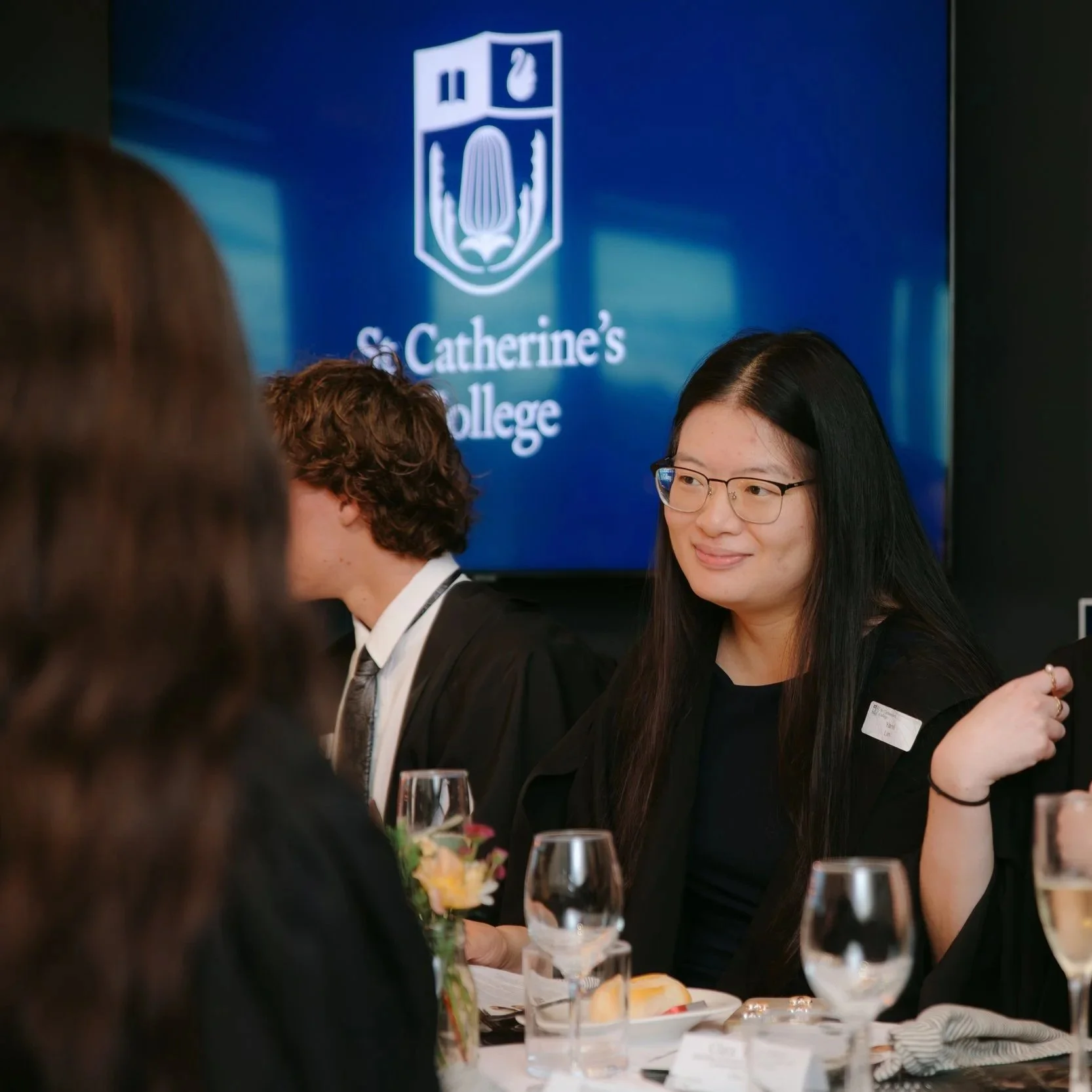
Dr Yanlin Lin our recent Faculty & Industry Dinner.
None of this requires us to treat digital life as the villain. Social media, messaging apps and online college channels are now part of how students organize themselves, stay informed and keep in touch. The more useful distinction is between connections that remain surface-level and connections that help students become more present to the place and people around them. At its best, college communication helps students see where they might belong: which dinner to attend, which club to try, which conversation to join, and which opportunity might draw them out of their room and into the life of the College. That is how communication begins to strengthen community rather than simply add to the stream of content.
Perhaps that is the most encouraging way to think about the attention economy in a college setting. If attention is precious, then places that help students use it well become even more valuable. The goal is not to compete endlessly for attention, but to help turn it into something richer: deeper learning, stronger friendships, a greater sense of belonging, and a community in which students feel known, supported and involved. In that sense, attention is something that can and should be cultivated; and when it is directed towards people with purpose and shared goals, it becomes one of the foundations of a flourishing college community.
Expand Your World. Book a tour of the College.
Learn more about our Resident Fellow program.